Navigating Change: Key HR Priorities for 2026
As organizations move into 2026, business leaders are navigating an HR landscape shaped by rapid technological change, evolving workforce expectations, and increasing pressure to do more with less. The traditional HR playbook focused on programs, policies, and compliance alone is no longer enough. Today’s most effective people strategies are intentional, backed by data, and deeply human at their core. From safely optimizing AI to unlocking the potential of both future and existing employees, the role of HR is expanding. The following six HR priorities highlight where leaders must focus in 2026 to build agile organizations that attract, retain, and grow the talent they need for what comes next.
1. Safely Optimizing AI: Innovation with Guardrails
AI is no longer a future concept – it already exists in many of the tools organizations use every day, from applicant tracking systems to search platforms. In 2026, the focus for HR is not whether to use AI, but how to use it responsibly. The most effective organizations are those that embrace AI’s ability to reduce busy work and support better decision-making, while maintaining clear boundaries. As Alisa Kline, Flex HR’s Director of Consulting, reinforced during our recent 2026 HR Trends webinar, “We embrace it, but we embrace it with guardrails.” AI can help summarize information, identify patterns, and improve efficiency, but it should support decisions, not replace them. Specifically, when it comes to people-related outcomes, humans must be the decision-makers.
Education and data privacy are at the center of safe AI adoption. One of the greatest risks organizations face is the misuse of sensitive information. “One of the biggest mistakes we can make is violating our employee’s privacy,” notes Alisa. Employees should be trained to never input identifiable employee data, to use anonymized or aggregated information, and to assume prompts and searches could become public information. Organizations should also limit AI use to approved, secure platforms. Clear guidance empowers employees to use AI confidently while protecting both the company and its people.
Finally, strong AI governance reinforces the non-negotiable role of human judgment. Many low-risk applications, like drafting job descriptions or editing documents for tone and clarity, can deliver immediate value. However, AI is only as accurate as the humans guiding it. Conducting an AI audit can help organizations understand how tools are being used across teams and where policy clarity is needed. When developing AI policies, providing both acceptable and prohibited use examples sets clear expectations for usage. As long as AI remains a tool and not the decision-maker, organizations can safely optimize innovation without losing the human element. After all, people make the decisions, not systems.
2. Managing Rising Benefits Costs
Rising benefits costs continue to put pressure on employers, with no sign of slowing. In 2025, annual employer-sponsored family health insurance premiums reached nearly $27,000—up 6% year over year and far outpacing general inflation (SHRM). With continued increases expected due to factors like hospital pricing and high-cost specialty medications, many organizations are feeling the strain.
In response, HR leaders are being pushed to think more creatively about benefits strategy. This doesn’t necessarily mean offering less but offering smarter. Employers are exploring plan design changes, alternative funding arrangements, enhanced employee education, and more targeted wellbeing initiatives to help manage utilization and cost. Transparency and communication will also be critical; employees need to understand both the value of their benefits and the realities driving cost decisions. In 2026, benefits strategy is as much about sustainability as it is about competitiveness.

3. Embracing Change in Recruitment Practices
Recruitment in 2026 is undergoing a meaningful shift, driven by tighter labor markets and changing candidate expectations. One of the most significant changes is the growing emphasis on skills-based hiring. In a recent webinar, Natalie Morrissey, Director of Recruitment with Flex HR shared, organizations are increasingly hiring candidates for what they can do, not simply what they have done. This shift requires employers to look beyond traditional credentials like education or previous work experience, and focus on capabilities, potential, and alignment with the work itself. When done well, skills-based hiring allows organizations to make more thoughtful decisions around placement, training, and ongoing management—leading to stronger engagement and performance.
In practice, skills-based hiring means rethinking how roles are defined and how talent is evaluated. Job descriptions are becoming more focused on the skills and outcomes that truly matter, rather than rigid experience requirements. This approach also creates faster pathways for non-traditional candidates and those in high-demand talent pools. Data shows that organizations using skills-based hiring see higher satisfaction among both employers and employees, often resulting in reduced turnover. “If your organization is ahead of the curve on this, you’re getting access to a very scarce market of talent,” says Natalie. In a competitive hiring environment, expanding who you consider “qualified” can be a powerful differentiator.
At the same time, recruitment practices are being reshaped by evolving DEI strategies and increased salary transparency. While some employers are pulling back from broad DEI messaging, the focus is shifting toward measurable, job-relevant practices that support fair and compliant hiring. It’s critical to remember that regardless of changing priorities, adherence to fair hiring laws remains non-negotiable. Salary transparency laws have also reset candidate expectations. Even in states without current requirements, that doesn’t mean it’s not on the horizon. Candidates today have more information, more options, and less patience for salary gatekeeping, making it essential for employers to stay ahead of pay transparency regulations and ensure job postings reflect compliant and competitive compensation practices.
4. The Push for the Internal Talent Marketplace
Alongside changes in external recruitment practices, organizations are increasingly recognizing that the talent they need may already be on their payroll. Internal talent marketplaces – whether supported by formal platforms, structured processes, or integrated systems – are emerging as a powerful way to connect employees with new roles and projects inside the organization. Rather than relying solely on external hiring, these marketplaces allow companies to surface existing skills, identify adjacent capabilities, and redeploy talent where it is most needed.
Beyond efficiency, internal talent marketplaces create a more people-forward organization. Employees gain visibility into career pathways and development opportunities, while leaders benefit from greater agility and reduced turnover. In a labor market defined by rapid change, organizations that can quickly match internal talent to evolving business needs will have a distinct competitive advantage. The message to employees is equally important: growth doesn’t require leaving the company, it can happen within it!
5. Preventing Burnout in 2026
Strategic recruitment may get employees in the door, but culture is what keeps them there. In 2026, burnout remains one of the most persistent – and misunderstood – workplace challenges, particularly in the months following onboarding. When the day-to-day employee experience fails to match recruitment promises, the damage goes beyond engagement and retention; employer brand suffers as well. “Burnout looks different in 2026,” says Paula Baldocchi, Implementation Manager with Flex HR. Rather than showing up as obvious exhaustion, burnout is often driven by chronic workload, emotional dysregulation, and unclear roles, and it frequently goes unnoticed until it’s too late.
Critically, burnout is not an individual failure; it’s a systems signal. It appears long before turnover and is often mistaken for something else. Preventing burnout in 2026 requires intentional culture design. Many organizations are renewing their focus on emotional intelligence and building environments that regulate stress rather than ignore – or worse – reward it. This starts with training leaders to create psychological safety. As Paula notes, “Without psychological safety, we have no growth, no progression, no retention. That is our building block.” Leaders must also model the behaviors they expect to see by improving decision hygiene, clarifying roles and expectations, and demonstrating healthy boundaries. When paired with accessible mental health resources, these actions send a clear message: well-being is a responsibility shared across the organization.
6. Taking Action to Build the Next Generation of Leaders
Another critical cultural initiative is the intentional development of your future leaders. In 2026, leadership development is no longer a “nice to have”, it’s a business imperative. According to research, 86% of HR leaders say their organizations will need long-term strategies to develop leadership skills, yet only 20% report having leaders ready to fill critical roles today. This gap represents one of the most significant risks organizations face heading into 2026.
What’s changing is the expectation that leadership development must move from intention to execution. Organizations can no longer rely on informal mentoring or hoping high performers will naturally step into leadership roles. Instead, they must take deliberate, measurable steps to identify leadership potential early, provide targeted development opportunities, and expose future leaders to real-world challenges. This includes rotational assignments, stretch projects, coaching, and clear succession planning. Companies that fail to invest now may find themselves unprepared when leadership backfills are necessary.
Preparing for the Year Ahead
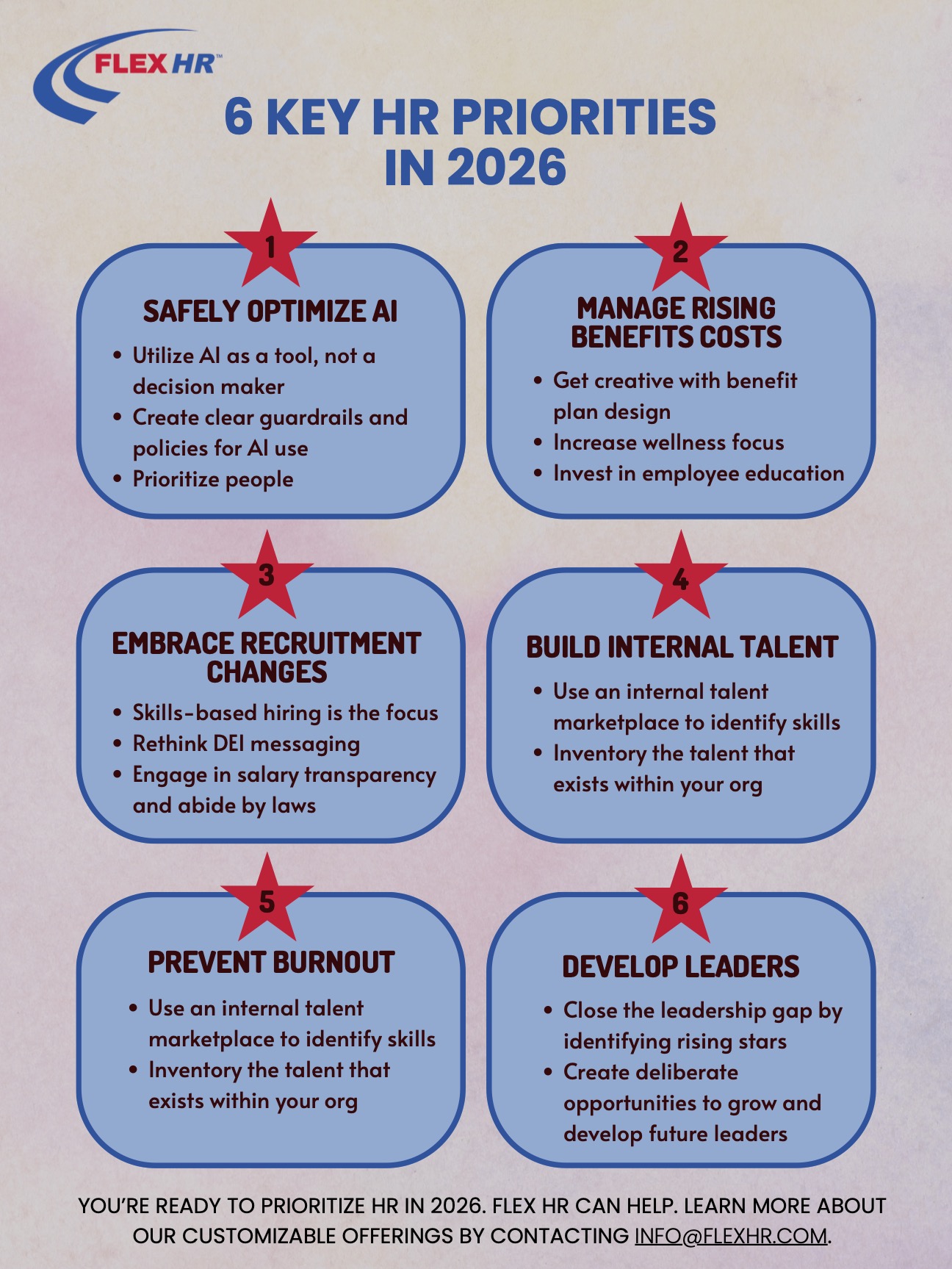
As these trends reinforce, 2026 will be shaped by how intentionally organizations invest in their people, the technology they use, and the systems that support them. Business leaders are being asked to balance innovation with responsibility, efficiency with empathy, and short-term demands with long-term sustainability. Organizations that approach these challenges proactively will be better positioned to build resilient cultures and adaptable workforces. For leaders looking to continue the conversation and explore practical guidance for the year ahead, Flex HR’s 2026 Priorities Webinar offers additional insights and perspectives to help navigate what’s next. For a quick, practical reference, download our one-page PDF outlining the key priorities and recommended actions.
Navigating these changes doesn’t have to be done alone. In fact, nearly 80% of organizations outsource at least one HR function. Partnering with a leading HR outsourcing firm like Flex HR will not only improve your bottom line, it will set your business up for long-term success. If you’re looking for a strategic partner to help translate 2026 HR trends into practical action, the Flex HR team is here to help. Learn more today!